

This piece was featured in Issue 25 of Works in Progress. Subscribe today to get Issue 25, and an issue every two months after, delivered straight to your door.
Martin Gould and Koji Flynn-Do explain why animals’ lives might, finally, be about to get better.
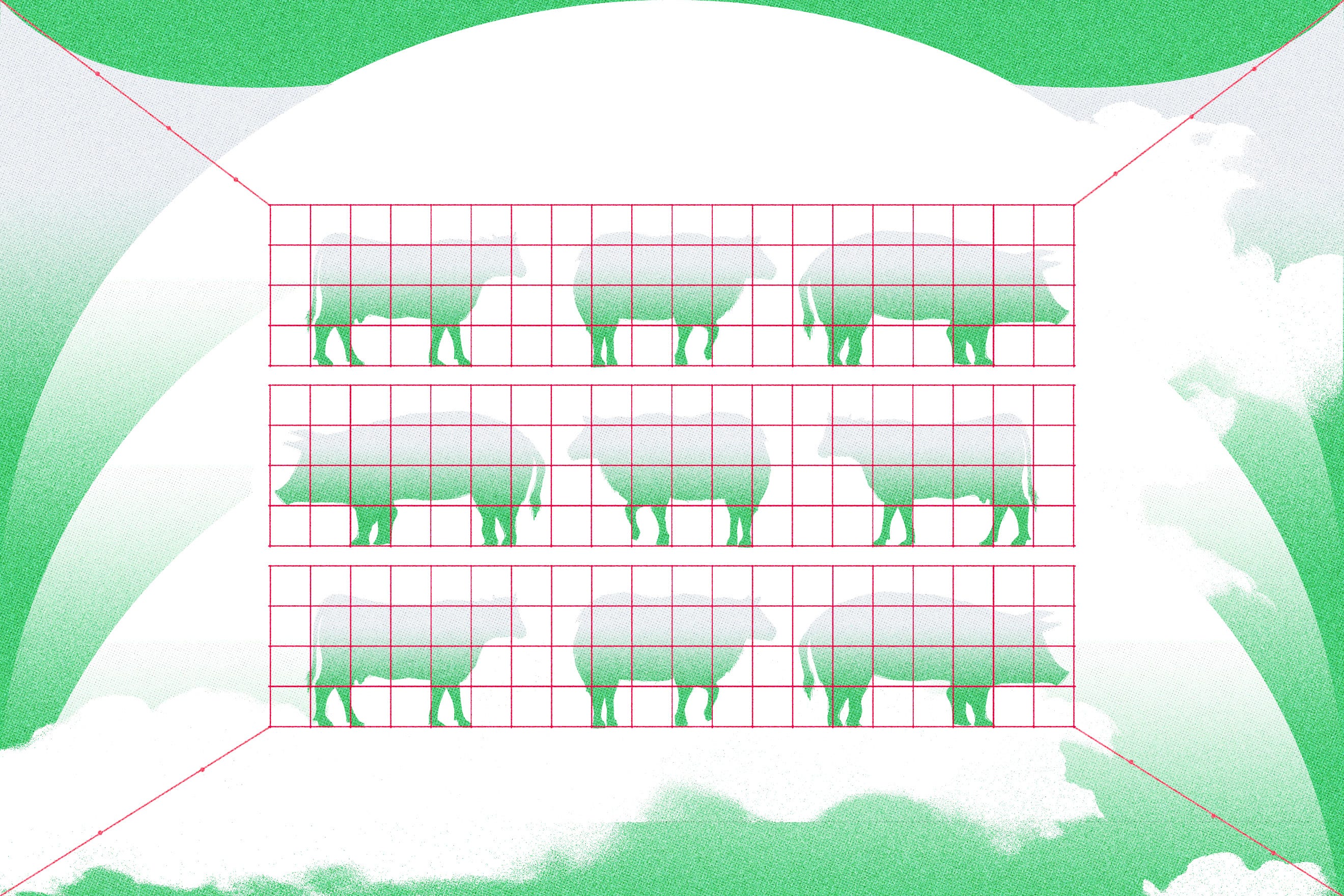
In September 2022, a new kind of pig farm opened in China: a twenty-six storey high-rise in Ezhou, near the Yangtze River. Months later, a second tower went up. Inside, pigs are kept by the tens of thousands on each floor, monitored by cameras and fed, watered, and moved with mechanical precision. More than a million pigs are born, raised, and slaughtered each year without ever setting foot outside.
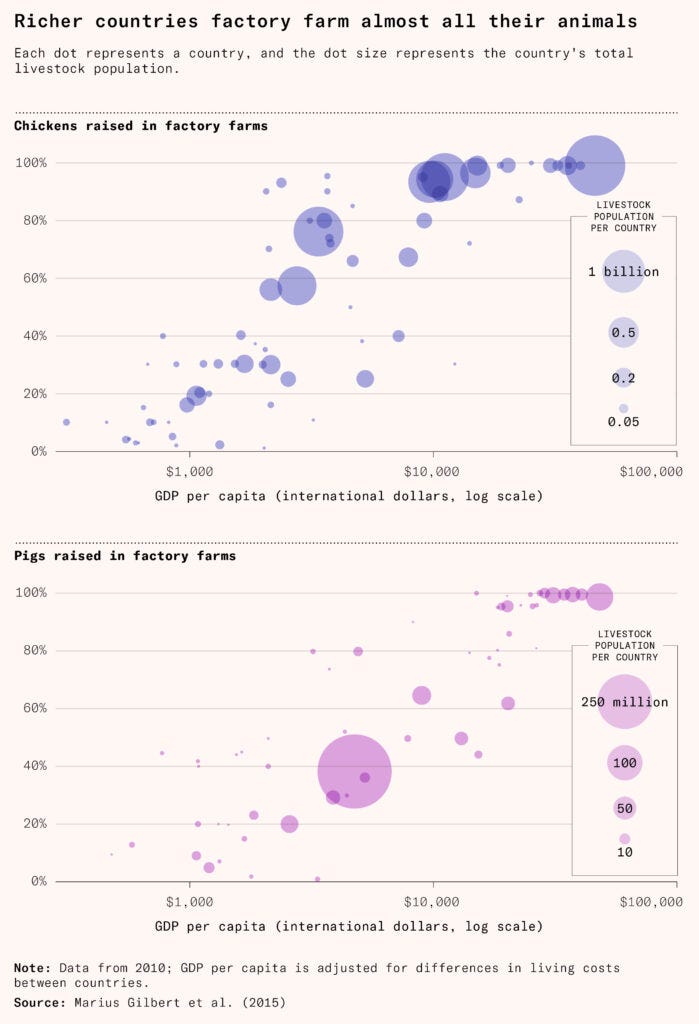
These high-rise factory farms are only one example of a common pattern. As countries get wealthier, farming consolidates into fewer, larger, more brutal farms. Once average incomes reach around $1,000, chicken farming starts to industrialize. By the time a country reaches $10,000, the vast majority of chickens are raised in battery cages. In countries with average incomes above $30,000, almost all pigs are raised in warehouses.
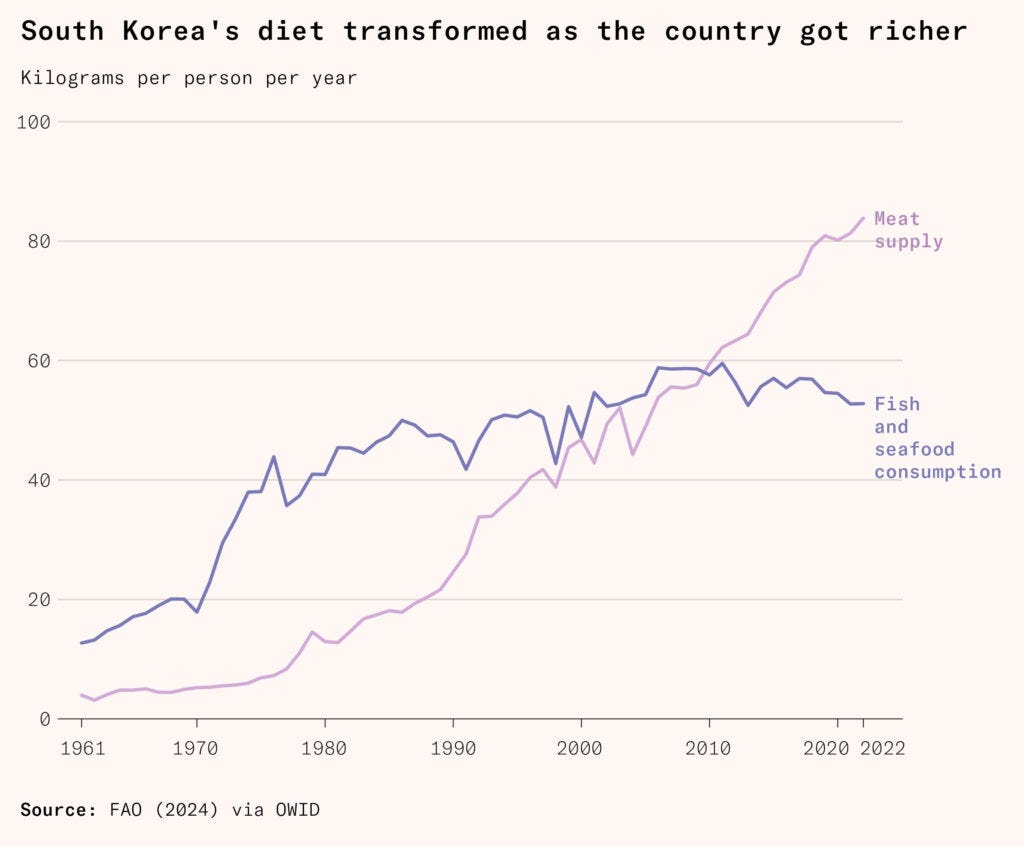
Factory farming exists to meet rising demand for meat. Meat is tasty, nutritious, and much more expensive than rice or bread. As people get richer, they want more of it. When Park Chung Hee took power in 1961, South Korea’s meat supply was around four kilograms per person per year, less than the weight of two chickens. When his rule ended in 1979, that figure had quintupled. By 2000, it had increased tenfold. Today, the average South Korean eats more than 120 kilograms of meat and seafood combined per year.
In poor countries, where inadequate nutrition is the norm, rising meat consumption is good for people’s physical development and health. Diet is only part of the story, but the pattern is unmistakable. In South Korea, average male height has increased from around 160 centimeters in 1961 (five feet three inches) to around 175 centimeters (five feet nine inches) today. Chinese men have seen a similar height gain: from around 165 centimeters before the country industrialized to around 175 centimeters today.
But industrially farmed animals suffer immensely for it. Chickens’ beaks are frequently sheared off and their legs are too weak to support their bloated bodies. Pigs have their tails docked and teeth clipped without anesthesia, and mother pigs live much of their lives in gestation crates too small to turn around in. These lives are not worth living. The question is whether such brutal treatment is inevitable.
For many of modernity’s worst problems, a combination of affluence, maturity, and political pressure has created self-correcting mechanisms over time. As countries got richer, things that initially worsened due to industrialization eventually improved. Will industrial meat production follow the same path?
The Kuznets curve
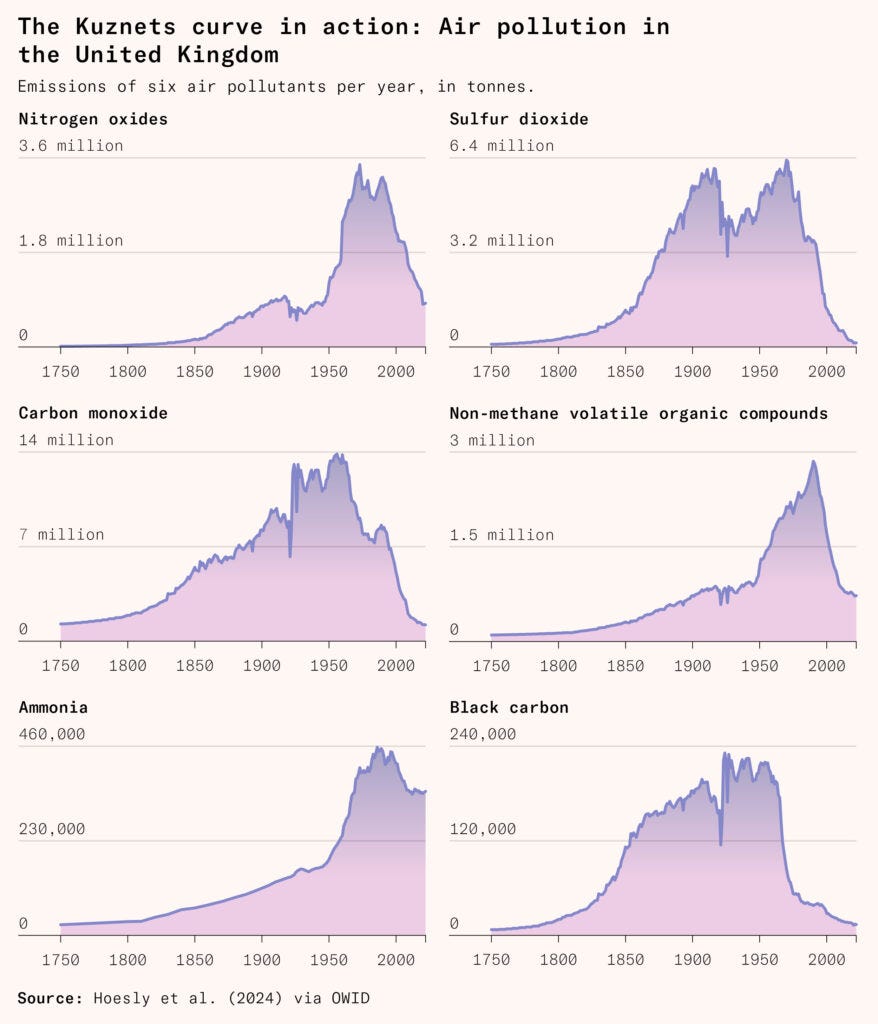
In his 1853 masterpiece Bleak House, Charles Dickens memorably described the air pollution of industrializing London: ‘flakes of soot … as big as full-grown snowflakes’. When Dickens was writing, London’s air pollution had been steadily worsening for decades as Britain industrialized, and it would continue to worsen for nearly half a century longer. But had he returned a century later, he would have found the dirtiness of London’s air to have halved, and by 2000, it would be less than a tenth as dirty.
Growing economies and populations have historically driven deforestation. But improvements in crop yields have halved agricultural land per person since the Green Revolution of the mid-twentieth century. The rate of global forest loss peaked in 1980, and forest loss typically reverses when average incomes enter the range between $5,000 and $15,000, as farming becomes more efficient and marginal farmland reverts to nature.
These trajectories are called Kuznets curves, after the economist Simon Kuznets, who suggested that economic inequality rose as countries first industrialized but then fell as they became even richer. His curves appear in many places. Wealthy areas clean up their local air, forests, and factories. Their inhabitants are less obese than those of industrializing countries, and have more leisure time and better working conditions.
But Kuznets curves don’t appear in all places, especially not when the industrial activity has no direct costs for the rich country. Emissions have fallen substantially in Germany and Britain, but much less in America and Australia, which remain some of the world’s biggest carbon emitters. The total amount of material people consume, and the amount of waste they generate, do not seem to decline but rather keep growing. The question is whether animal suffering is closer to child labor, and will decrease as we grow richer, or to waste generation, meaning animals will continue to suffer in ever-greater numbers.
How much meat do we eat?
Start with consumption. In about ten European countries, including Germany, Austria, the Netherlands, and Denmark, meat consumption per capita appears to have peaked. Northern Europeans ate far more meat in the early 2000s than they do now.
Walk into a German supermarket today and the change is visible. The queue at the butcher counter has thinned; the same floor space now splits between marinated chicken, ready meals, and plant-based sausages. Pork, once the unquestioned centerpiece of German cuisine, has lost its grip: consumption fell over 10 percent just in the five years before 2025. The shift is even more noticeable in institutions. Forty years ago, a daily university menu would have centered on schnitzel and pork stew. Today, similar establishments compete to offer the best vegetarian and vegan options. In 2021, 34 cafeterias across Berlin’s universities moved to menus that were 96 percent plant-based.
But many rich countries aren’t like Germany or Denmark. Average incomes reaching $40,000 or $50,000 do not reliably herald a decline in meat eating. A more common story is a plateau. This is not bad news, as it implies that there is something of an upper limit on meat consumption. The plateauing countries, like Portugal, Spain, the United States, Britain, South Korea, and Australia, have all reached a ceiling of around 150 kilograms of meat per person per year.
Whether this ceiling holds may depend on shifting dietary fashions. Faddish new guidelines recommend eating two grams of protein per kilogram of body weight every day. If half of that protein were meat, the average American would need to double their meat consumption to meet the target. Drugs like Ozempic suppress appetite and reduce total caloric intake, but evidence suggests users shift toward protein-rich foods to preserve muscles, which could mean less food overall, but with perhaps a higher share of it meat and dairy.
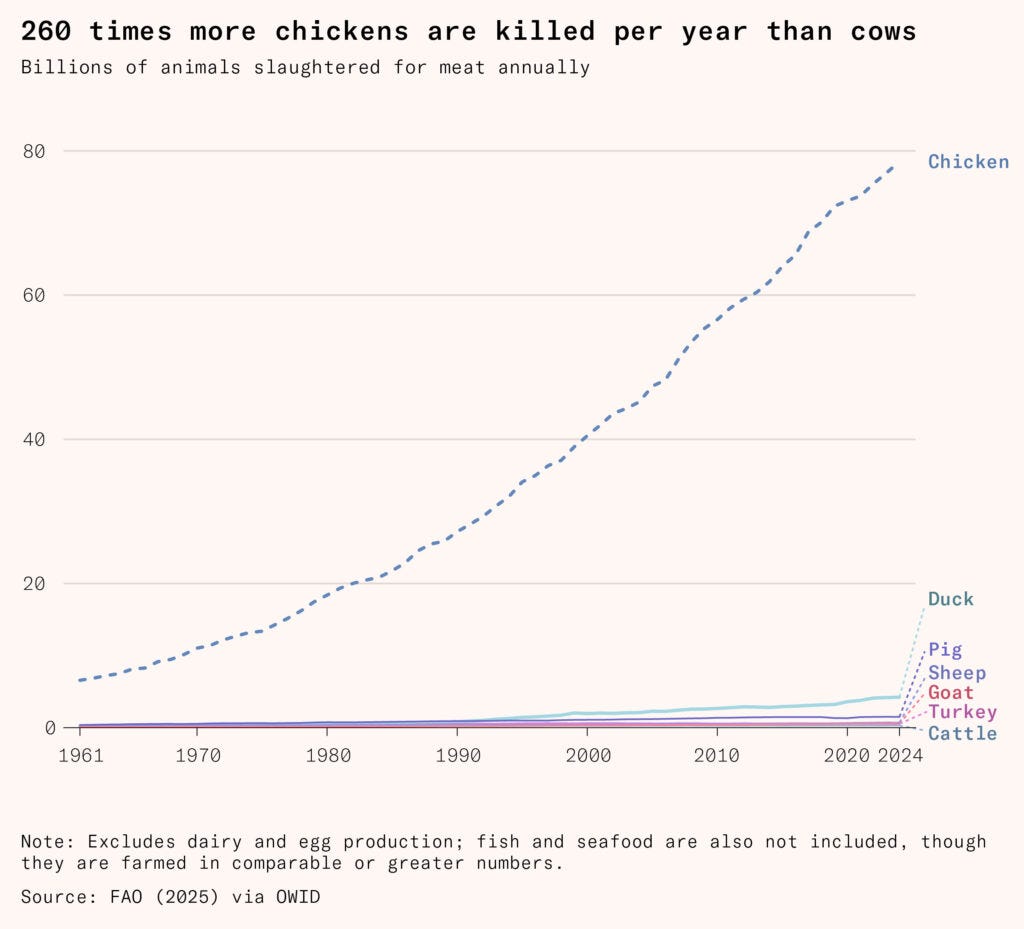
More importantly, the kind of animal being eaten has changed. While Germans, Austrians, and Danes are consuming less meat, their diets are leading to the farming of more animals. In 1980, the average German diet required the slaughter of about ten farmed animals per year: roughly six chickens, one and a half pigs, and a third of a cow. By 2022, even though Germans were eating a fifth less meat, that number had doubled to twenty animals, largely driven by the shift to chicken and farmed fish: roughly 14 chickens, a bit less than one pig, one sixth of a cow, and six farmed fish.
From a welfare perspective, that makes a tremendous difference. Beef implies perhaps a day or two of suffering per kilogram, whereas chicken implies dozens of days of suffering per kilogram and farmed fish hundreds or thousands, depending on the species.
How we treat farm animals
Perhaps the continued high meat consumption in rich countries should be expected. The Kuznets curves for emissions of sulfur dioxide, particulate matter, and water pollution were not created by people consuming less. They were produced by people consuming differently. Cities increased the amount of heating in homes, but replaced coal with natural gas. People wash more laundry than ever, but the detergents no longer include phosphates. The way down the curve might not require people to eat less meat, but simply to produce it better.
For decades, the animal agriculture industry has focused on efficiency: cheaper feed conversion, faster growth, more animals per square foot. The result is that meat, eggs, and dairy are historically cheap. In 1946, the average American factory worker had to work more than half an hour to buy a pound of chicken. Today it takes four minutes. That single-minded focus on cost means there are now a lot of cheap, simple changes farmers can make to improve animal welfare.
Egg production is one example. For almost a century, farmers around the world have confined laying hens to battery cages offering less than a sheet of paper’s worth of floor space per hen. This comes at considerable cost to the welfare of hens, who cannot perform natural behaviors like spreading their wings, dustbathing, and nesting.
In wealthy countries, consumers and companies have shifted to producing and purchasing more cage-free eggs. Today, 45 percent of American, 62 percent of European, and 82 percent of British hens are kept in cage-free facilities. That amounts to hundreds of millions of hens spared from cages each year. Hens get two to three times as much floor space, which means each egg costs one or two cents more to produce. Richer consumers are willing to absorb those small costs.
In some countries and regions, cages for hens have been eradicated at the ballot box. Voters in rich places like Switzerland, Massachusetts, and California have elected to ban battery cages with resounding majorities. The Swedes didn’t even need legislation. By 2025, almost all hens in Sweden were cage-free thanks to retailers and shoppers rejecting caged eggs.
Other practices in husbandry are following a similar path. The European Union and United States now both require cattle and pigs to be stunned before slaughter, though exemptions exist for religious slaughter. Crates that confine pregnant sows and baby cows to spaces too small to turn around in have gradually been banned across the European Union, New Zealand, and several US states since the 2000s. Tail docking and castration without anesthesia, once standard for pigs, are restricted in the European Union and Britain.
New technologies can reduce suffering even further. In ovo sexing allows farmers to figure out the sex of chicks at the embryo stage, discarding eggs containing males. Adopting the technology means farmers avoid gassing or grinding up male chicks on their first day of life. The practice has already spared hundreds of millions of chicks from that fate in Europe, and has only just started spreading in the US.
Overall, these welfare improvements aren’t enough to offset the increased number of animals being farmed around the world. The sheer growth in the number of animals consumed, particularly chickens and fish, swamps the gains from better treatment. But in a few countries, the combination of declining meat eating and improved treatment is plausibly decreasing total farm animal suffering. New Zealand has banned battery cages, restricted sow crates, and mandated pre-slaughter stunning, and is also eating far less meat. The same may be true in Germany, Sweden, and a handful of other wealthy European countries. They offer a glimpse of what the other side of the curve might look like.
Bending the curve
Income needs to reach a certain level before things can start to change. Whether you ask people in Sudan or Singapore, roughly the same share – between 70 and 90 percent – will tell you that they believe farm animals experience suffering and that their welfare matters. What changes with wealth is willingness to pay. In European surveys, 42 percent of the poorest quintile say they would pay more for higher-welfare products. Among the richest quintile, it’s 72 percent. No poor country has bent the curve: New Zealand has an average income of $45,000, Germany $55,000, and Denmark $65,000.
But income alone doesn’t guarantee progress. There are many countries that have surpassed these income levels and still have increasing meat consumption and less stringent farm animal welfare reforms than their peers. These include large economies like Japan, South Korea, and the United States.
Animal welfare improves fastest when the technology is already cheaply available. Stunning machines for chickens and pigs and cage-free housing systems for hens were cheap and effective before they started to be adopted at scale. Plant-based meat alternatives or lab-grown meat have yet to make any real dent in animal suffering: the entire alternative meat industry has yet to reach more than 2 percent market share for meat overall. This is easily explained by costs.
The only cultivated meat currently sold in supermarkets comes from a Singaporean company: a shredded chicken product that is 3 percent cultivated chicken cells and 97 percent plant-based, and retails at more than twenty dollars per pound. That is roughly ten times the price of conventional chicken and around five times the price of even premium products like pasture-raised chicken.
The failure of alternative proteins to make much of a difference in the past few years does not look so damning when we look at other Kuznets curves. For most of the twentieth century, leaded gasoline poisoned children’s blood across the developed world until lead levels plummeted within a decade of countries phasing it out in the 1970s. The air pollution that Dickens encountered steadily worsened for two centuries before its precipitous decline. Those curves began to bend when the problem became undeniable at the same time as a workable substitute existed. If indeed there is a Kuznets curve for animal suffering, it may take a tremendous amount of time and effort before we see the other side. What we see now is only a glimpse.
Koji Flynn-Do is chief of staff for US policy at LawAI.
Martin Gould is a Program Officer at Coefficient Giving.
Reminds me of the fact that farmed salmon needs additive color since they don't develop that beautiful pink hue in their water pens
Thank you for this article. Kuznets curves are an important tool in several major areas, especially environmentalism, and there is a need to apply them to animal welfare.
That said, the balance of evidence on EKC is rather ambiguous. For some environmental impacts, some researchers have found evidence of Kuznets curves. For other impacts, the evidence is weak or nonexistent.
The biggest theoretical issue with the EKC is empirical results are usually determined from cross-sectional data, but they are employed to make temporal claims. The two are often very different. In my work on urban scaling, I frequently find the same problem whereby scaling research also conflates cross-sectional and temporal data.
Optimistically, I think there is a good case to be made that increasing wealth creates the conditions for better welfare standards, and in the long run, less animal meat consumption overall. But realizing those conditions requires the hard and contentious work of policy change and cultural values, for which increasing wealth alone is no substitute.