


Subscribe to the print magazine before the end of February and get a copy of Issue 22 sent immediately, and further issues every two months.
When How Asia Works appeared in 2013, the prevailing mood was one of considerable optimism. China seemed a triumph of economic development. Between 1990 and 2013, China averaged a real annual growth rate of ten percent. It added almost half a billion urban residents and quintupled its manufacturing output. And other Asian economies were moving along comparable trajectories, if less spectacularly. Growth in India and parts of sub-Saharan Africa lent further weight to the idea that the developing world was at last catching up.
How Asia Works was Studwell’s theory of what drove this growth: land reform, export discipline, and states willing to impose hard constraints on capital. Beneath Studwell’s specific prescriptions lay a bolder claim: that countries were not condemned by geography, history, or culture to particular economic outcome, and a relatively small number of well-chosen policies could make an enormous difference. Tyler Cowen called it the best treatment of Asian industrial policy available. Noah Smith named it his favorite book on development. Bill Gates made the agriculture team at his foundation read it.
But a decade on, China’s growth has decelerated from over ten percent per year to around five. The rest of East Asia has settled into the one-to-three-percent range typical of mature economies. South and Southeast Asia continue to grow, but less spectacularly. And Africa, which once seemed poised to follow the same path, has not grown at all in per capita terms. Against this backdrop comes Studwell’s sequel, How Africa Works.
Against Afro-pessimism
How Africa Works opens with an account of the continent’s historical constraints. Studwell responds to what can be called the Afro-pessimist view: that postcolonial Africa was at least as wealthy as East Asia at independence, and that the subsequent divergence was a story of misgovernment. This widely held position, he argues, is premised on a mistaken reading of the limited quantitative evidence, driven by mismeasurement and temporary commodity booms at the moment national accounts were first assembled. The supposedly high incomes per person in Africa don’t match, for example, with the fact that life expectancy was two years lower than in South Asia and between 6 and 20 years lower than the level of countries in East and Southeast Asia.
What Africa inherited at independence was considerably worse than what most other regions had to work with. Population densities were less than 25 percent of those in East and South Asia, driven by limited arable land, disease burdens, the enslavement and export of 12.5 million people, and even the abundance of crop-destroying elephants. This blunted incentives to build states capable of projecting authority over territory.
Colonial and postcolonial land policy concentrated wealth among large holders rather than diffusing it broadly. Ethnic and linguistic fragmentation locked post-independence politics into patronage networks. And on top of all that, Africa entered sovereignty as the world’s least educated region. Africans who attended school did so for half as much time as South Asians, the second least educated population in the world. Out of a population of 15 million, what is now the Democratic Republic of Congo had just 30 university graduates when Belgium departed in 1960.

But Studwell thinks that the essential preconditions for growth – literacy, governance, and especially population density – are gradually falling into place across much of Africa. Today, Africa is about where east Asia was in the 1960s and. What is needed, according to Studwell, is the disciplined application of the three-part model that already worked in Asia: redistributing agricultural land to smallholders, who farm more intensively and whose rising incomes create domestic demand; channeling state support toward manufacturers that must compete in international markets, rather than sheltering them behind tariffs indefinitely; and directing credit toward investment by suppressing consumption.
Studwell illustrates the argument with four African cases: Mauritius, Rwanda, Botswana, and Ethiopia, countries that have either begun this process, or, in the case of Mauritius, more or less finished it.
The Asian model in Africa
The usefulness of the Asian model in Africa seems to hold up best for agriculture. Across the continent, governments often subsidized large farmers who were not necessarily more productive. In Ghana, for example, the Savannah Zone Agricultural Productivity Improvement Project was meant to benefit smallholders in the region, but only farmers with over 40 hectares and a tractor were eligible for subsidies.
Consolidation resulted in much more land held at medium-scale by urban elites, rather than by smallholders who had scaled up through accumulated expertise. But these farms weren’t necessarily more productive. Among medium-scale farmers in Zambia, only 11 percent of such farms were cultivated, compared to 91 percent of smallholder land.
When smallholder farmers did receive tenure security, training, and market access, they achieved remarkable successes. In Ethiopia, crop production more than doubled between 2004 and 2014, for example, and continued to grow during periods of crisis afterwards. Extreme poverty fell by over 25 percentage points between 2000 and 2015.
Beyond agriculture, the link between the East Asian model and Africa’s successes is harder to trace. Botswana is one of the richest countries in Africa, but didn’t start that way. It managed its diamond wealth with unusual discipline, by partnering with an experienced foreign firm, De Beers, on favorable terms, building reserves, investing in education and infrastructure, and maintaining a frugal bureaucracy. In negotiating with De Beers, the government was able to secure two thirds of the profits of diamond extraction. The returns were remarkable, as life expectancy rose from 48 to 65 in barely twenty-five years.
These are impressive achievements, especially given the country’s poor starting position. But Botswana neither supported smallholder agriculture nor created a manufacturing base. It devalued its currency to help beef exporters, not to spur industry. The government preferentially leased grazing land and directed subsidies to large farms. The result was a rapid concentration of livestock ownership: by the 1990s, five percent of the population owned half of all cattle, and nearly half of rural households owned none. Manufacturing subsidies were tied to headcount rather than exports, in a system that rewarded loyalty more than efficiency. It is telling that Studwell himself describes the country as a ‘gatekeeping state’ that managed wealth without knowing how to grow it.
Rwanda fits awkwardly too. It adopted something of the rhetoric of the Singaporean developmental state, attracted substantial foreign aid, and made itself, by the standards of the region, relatively easy to do business in. But with energy costs roughly five times those of neighboring Ethiopia, and a remote, landlocked position that gives access only to an extremely impoverished regional market, most of the resulting growth has come through tourism and services rather than manufacturing.
Mauritius comes closer to validating the model, given that it actually pursued export-oriented manufacturing and achieved real industrialization. But it did so at an early stage of development, as a small island economy. It never progressed far beyond basic manufacturing, pivoting instead to tourism and offshore finance, which happen to be precisely the sectors that Studwell, in How Asia Works, is most dismissive of.
The most compelling case, however, is Ethiopia. In 1991 it was by many reckonings the poorest country in the world. Under Meles Zenawi, the government consciously modeled its approach on the East Asian experience: devaluing the currency to support manufacturing, directing resources toward smallholders, channeling development finance into productive investment, and building, with some success, an administration oriented around growth rather than corruption.
In agriculture, the government expanded fertilizer distribution almost a thousandfold between 1995 and 1999. While droughts historically led to famines with death tolls in the hundreds of thousands, increased food reserves all but eradicated this concern.
But even in Ethiopia, the manufacturing story is thin. While massive industrial projects, including one of the largest dams in the world, reduced Ethiopia’s electricity cost to among the lowest on the continent, the results are limited. The successes he highlights are in low-value-added sectors like cement. Whether one looks at manufacturing as a share of output or at manufacturing value added per capita, there is little evidence that any large African country is genuinely following the East Asian path. The highest rate of manufacturing as a share of output for any African country with a population in excess of 10 million is Zimbabwe at 16 percent, compared with China’s 25 percent with 80 times the population.
‘It is likely that manufacturing – or its absence – will be the single biggest divider between African economic success stories and the nations that are left behind,’ Studwell writes at the end of chapter nine. But he spends remarkably little time in the book interrogating the extent to which that manufacturing growth is actually happening.
New headwinds to export-oriented manufacturing
Studwell contends that export-oriented manufacturing is the fastest route to broad-based growth, as it allows countries to build capacity on a scale that domestic demand could never absorb. Poor countries have an enormous pool of cheap labour, and that advantage can offset the productivity gaps, infrastructural deficiencies, and institutional weaknesses that would otherwise make competition with technologically advanced and better capitalized rivals impossible. This process tends to begin in the simplest industries. But expertise in one area of production generates spillovers into related ones, and the act of making simple goods builds the capabilities required to attempt more complex ones.
Even if Studwell’s view was once true, manufacturing-led growth has empirically become much harder. The evidence for this is visible in what economists have called premature deindustrialization, the phenomenon whereby poor countries are beginning to deindustrialize at substantially lower levels of manufacturing output, and substantially lower per capita incomes, than the West and other mature economies did.
If Studwell is right, African countries must now do to China what China did to the United States, Japan, and Europe. It is not obvious that the conditions for this are in place. While labor costs in Africa are between a half and a tenth of Chinese levels, this is far smaller than the fiftyfold difference between Chinese and American wages in 2000. All this must happen in competition with a country that has, by most measures, among the best logistics infrastructure in the world, very high labor productivity, and an industrial ecosystem without parallel.
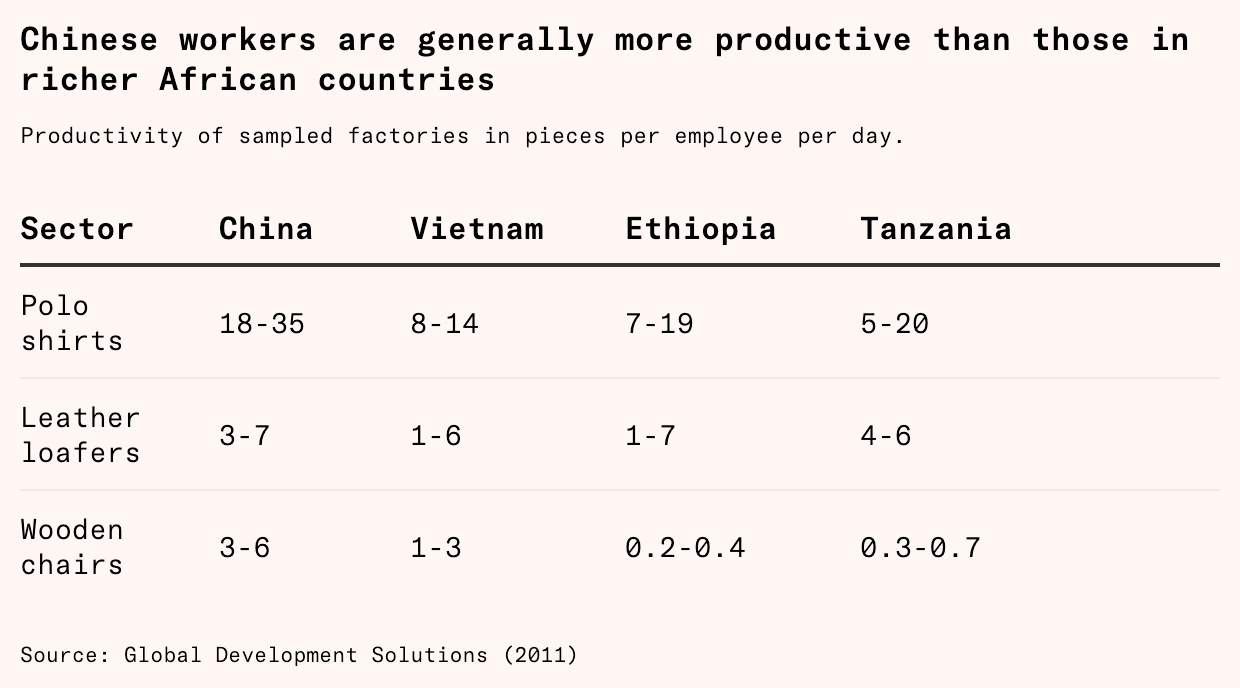
China remains by far the world’s largest textile exporter, comparable to its position in 2008, even as it has become the largest exporter of smartphones, semiconductors, and electric motors and batteries. Even where countries like Bangladesh have found niches, they have often struggled to move into more complex manufacturing the way the East Asian countries once did.
Nor is China the only headwind. The pace of globalization has slowed, and poor countries may not be able to compete on labor costs alone, as manufacturing now generates far fewer jobs per unit of output than it did in the 1960s. Automation is eroding the advantages that cheap labor once conferred. In America, manufacturing output roughly quintupled between 1960 and 2015, while employment fell by nearly a third. The implication is that wage competition may no longer provide the foothold it once did.
Several of these difficulties may be reinforcing one another, and addressing them would require a degree of generosity from wealthy countries that is not obviously forthcoming. The current American posture – sweeping tariffs and sharp cuts to foreign aid – is closer to the inverse of what the East Asian model would seem to require than to anything that might help it along.
The wrong kind of development
Africa’s starting endowment was uniquely difficult. Studwell’s considerable achievement is to show that this need not be fatal: that a state genuinely focused on development can exist in the African context, and that the obstacles, formidable as they are, are not insuperable.
But the development he charts is rarely of the kind he wants. He is dismissive of the services-led growth that Rwanda has pursued, insisting that countries need to focus singularly on manufacturing, without recognizing that the path may be much harder than before. While countries continue to deindustrialize earlier than before, services offer viable, if unspectacular, alternatives, and India’s experience suggests that a services-oriented economy can sustain growth well above the African average, even if well below China’s.
The book is most persuasive as a historical and agricultural diagnosis.The account of colonial land policy, resource extraction, and patronage politics is careful, and the case for smallholder agriculture is the strongest thing in it. But the manufacturing argument is much thinner. Studwell never quite confronts the possibility that the East Asian path is considerably more difficult to follow today than when it was first travelled. That the honest answer to his book’s central question may be that nobody knows is not a failure of the argument so much as a reflection of the moment. But a book more willing to acknowledge this would have served its subject better.
Saarthak Gupta is an analyst and quantitative researcher.
It was a great book, but it felt a little rushed and missed some aspects.
1) For example, one reason why Botswana'a manufacturing never took off is also due to South Africa's nationalist policies (even after apartheid) blocked out Botswana manufacturing with weaponizing rules in the SADC trade union.
In botswana, at the capital Gaborone, they had a Hyundai plant in the 1990s and it was successfully exporting tariff free cars to South Africa during the Mandela period. But many politicians, trade unions, and other interest groups in South africa did not like the competition, and wanted foreign factories to just come to South Africa.
Under Thebo Mbeki, South Africa insisted in SADC that the Botswanan cars didn't meet the "rules of origin" (the requirement that a certain percentage of a product must be manufactured locally to qualify for free trade).
South Africa aggressively applied steep tariffs and trade restrictions on the cars coming out of Botswana. Unable to access its primary consumer market, the Botswana Hyundai plant collapsed and was liquidated in 2000. Almost overnight, Botswana's auto manufacturing industry was wiped out.
Here's some reads on this if you care:
https://www.namibian.com.na/peugeot-is-namibia-industrialising/?hl=en-US#:~:text=Botswana%20tried%20this%2025%20years,was%20both%20cheap%20and%20reliable.
https://www.sundaystandard.info/botswanaocos-rand-5-2-billion-subsidy-to-the-south-african-automobile-industry/?hl=en-US#:~:text=Exports%20of%20automobiles%20became%20very,exports%20came%20to%20an%20end.
2) Also just a note, in the book Studwell mentions both Arab and European slavery. European slavery took 12.5M mainly from West, Central West Africa, and Mozambique, but Arab and North African slavery from the Trans-Sahelian, Red Sea, and Indian Ocean trade took millions of slaves as well from 6th to 19th century. So its much more than 12.5M slaves taken. He also mentioned how the lack of population density formed Africa's own domestic slave trade since people were more valuable than land.
3) I think he should have focused more chapters on the failures of manufacturing in african countries. Because almost all of them have very interesting attempts of industrialization in certain sectors that didnt pan out. It's a great book, but i didnt think it was as good as How Asia Works.
I write about the separate economic and geopolitcal histories of different african countries if anyone is interested. Here's me talking about Nigeria after the civil war:
https://yawboadu.substack.com/p/how-a-war-torn-country-became-a-petrostate?r=garki
East Asian model was in large part dependent on the US running large and persistent trade deficits for security and ideological reasons. The US opened up its market to Japan and then South Korea while both countries largely remained closed off to American products. In return, these countries, basically no longer had an independent foreign policy.
In the 1950s, US leaders made this choice knowing full well all the costs and benefits. By 1990s, a different generation of US elite truly believed in free trade as an end rather than just seeing it as a tool to be used. So China got to export to the US for another 2-3 decades without much issue.
But in 2026, US is no longer willing/able to absorb the world's surplus. China wants to export not import. Their leaders have seen the effects of deindustrialization on US and Europe and don't want to repeat the same mistakes. Their leaders are not ideological free traders. I don't think African manufacturing thesis is going to work out.