

We’re hosting a launch party for Issue 23 in Dublin on April 13th, and subscribers are invited. If you’d like to attend, sign up here. Not yet a subscriber? You can sign up for the magazine here. Plus-ones are welcome.
The Ogallala Aquifer sits under eight states and 111.8 million acres of US farmland. A windmill can lift only a few gallons per minute, useful for drinking water but useless for agricultural purposes. In the 1940s, electrification reached the Great Plains and a Colorado farmer invented center pivot irrigation, a sprinkler line on wheels that rotated around a central wellhead. The 1949 version could lift thousands of gallons per minute and irrigate 40 acres.
Since then the aquifer has lost 286.4 million acre-feet of water, comparable to draining Lake Erie entirely. The parts of it beneath arid states have seen much bigger drops. Large parts of Western Kansas have lost 50 percent of their aquifer depth. Texan wells are down as much as 265 feet. On current trajectories, the water there will be gone in 20–30 years.
Before center pivot irrigation, everyone could use as much of the Ogallala Aquifer as they were physically able to extract without any risk of depletion. An incredible invention created a tragedy of the commons. The southern Great Plains will have to ration water use by some mechanism, probably water charges, or face the total end of irrigated farming.
This is only one example of a common historical story. Fish catch sizes were limited until radar, sonar, and diesel engines; the North Sea Cod population collapsed a few decades after their invention. The telegraph led to the extinction of the passenger pigeon by letting hunters easily communicate about the whereabouts of the flocks. Chlorofluorocarbons almost killed the ozone layer. Technologies can collide with common-pool resources and drive them into extreme scarcity.
The Roadgallala aquifer
This is about to happen again. Road transport, especially the private car, is the dominant mode of transport in every country around the world. None of these countries charge at the point of use for the bulk of their road networks. When traffic gets slow enough – ten miles per hour in Tokyo and eight in Paris – people switch to other modes of transport because they can’t do much else when they are stuck behind the wheel.
This constraint is about to be lifted. Self-driving cars are not a hypothetical future but a familiar part of the urban background in San Francisco. I have driven in them several times and the novelty of seeing a steering wheel turn itself has pretty much worn off. During 2026, Waymo service will expand to Dallas, Houston, San Antonio, Orlando, and Miami, joining Atlanta, Austin, Los Angeles, San Francisco, and Phoenix.
Right now, self driving is a premium experience, more expensive than a human driver, in part because Waymo uses new cars, and in part because there are still relatively few Waymos on the road, spreading operational overheads thickly on a small fleet. Over time, Waymo and its competitors will become cheaper than human-driven taxis.
You make driving fun
Self-driving cars need not look like traditional cars inside. Normal cars are heavy and bulky, in large part due to safety requirements. Despite sharing the road with human drivers, Waymos already have 80 percent fewer accidents. When self-driving cars become 90 percent of the cars on the road, they will be able to platoon and join up into little trains, saving the space usually spent on gaps between vehicles and doubling road capacities.
They can be more comfortable as well. The Volkswagen GEN.TRAVEL has seats that fold out into flat beds, with passenger restraints for safe sleeping while moving and lighting designed to generate natural circadian rhythms. The Volvo 360c offers a first-class private cabin with a classic Volvo touch: a special safety blanket that acts like a seatbelt, usually loose and comfortable but tightening instantly on impact. In theory it can be an entertainment space or a mobile office too. Simpler, working versions of this idea, like the Amazon Zoox, are already driving around Las Vegas and San Francisco.
With imagination, you can see how a wide range of functions could be performed in a car: working, sleeping, eating, and even socializing, effectively bringing back the bar cars once enjoyed by New York commuters to Connecticut. I already buy cans of beer for long train rides with my friends. Train lines created entirely new seaside resorts like Atlantic City in the US, and Heringsdorf, Ahlbeck, and Bansin in Germany. Just imagine the trips people would make with the ability to effectively travel business class in their cars, driving overnight.
Our gridlocked future
Autonomous vehicles are the centrifugal water pump of the roads. Just like the Ogalalla Aquifer, most roads are currently free at the point of use. And just like the Ogalalla Aquifer, they will be overused if we do not charge for the privilege of drawing on them. Anyone who needs to get where they’re going quickly will be stuck in traffic with all the people enjoying a beer, working from a mobile office, or having a nap. There will be total gridlock.
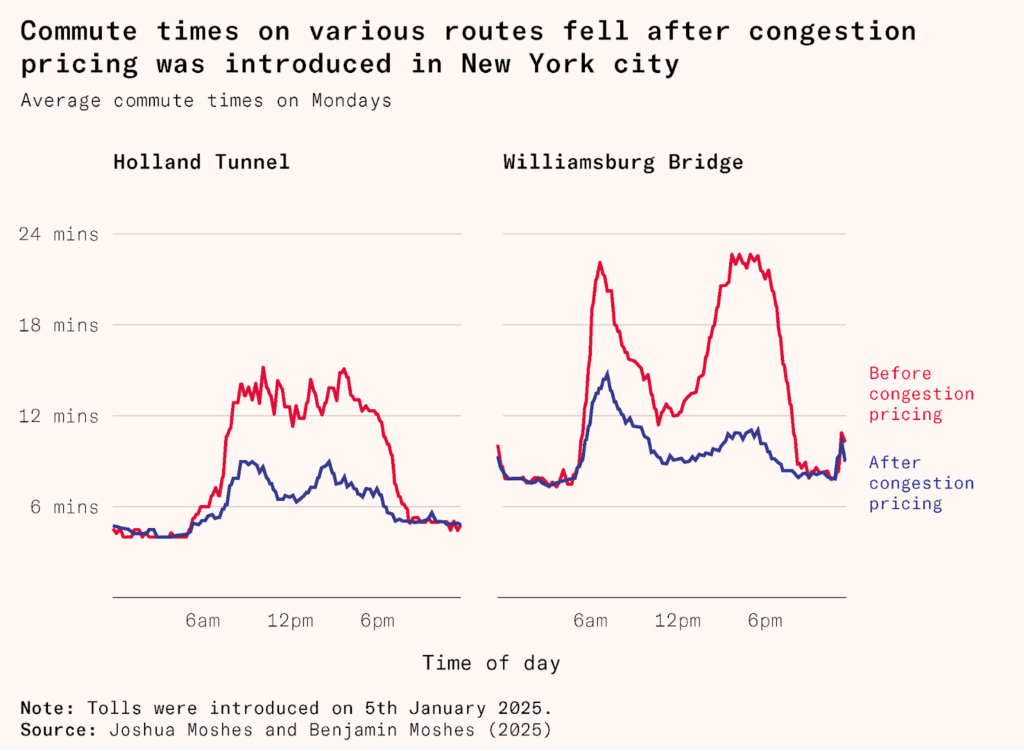
Though taxes on fuel and registering cars are universal across the developed world, imposing charges at the point of use has been trickier. It took New York City 60 years to impose congestion pricing, and it was almost revoked several times along the way. London’s congestion charge has survived, but attempts to extend it out of the very inner core have not. Dutch voters destroyed per-mile charges, the Kilometerheffing, in 2010. Hong Kongers rejected such a scheme in the 1980s, despite an effective trial.
These attempts failed for a range of reasons. But a major one is that they aimed to change the rules of the game for everyone at the same time, creating a lot of people who lost out under the policy while giving them nothing in exchange.
Tax doesn’t have to be taxing
There are two tricks to making new levies politically durable. First, a quid pro quo: drivers are much happier to pay if they get something in exchange, usually infrastructure. Second, grandfathering: drivers don’t like the price of anything they have already accounted for, including road access, to change, but they don’t mind high prices on new things. Fuel taxes are an example of a quid pro quo: in most developed countries, they entirely cover the cost of road construction and maintenance. Tolls, which are usually charged on new tunnels, roads, lanes, or bridges, are an example of both.
The Harris County Toll Road Authority, created by referendum in 1983 to fund the construction of two new roads, now manages 128 miles of roads around Houston, Texas. Voters have continually opted to expand it. Forty-three percent of the lanes added to California highways between 2018 and 2023 have restricted access, whether by requiring vehicles to carry multiple passengers or charging a toll.
Nearly all of France’s motorway system was funded by tolls, as are Japan’s and Austria’s. Voters accept these charges because they both generate a quid pro quo, new infrastructure in exchange for new money, and they keep old infrastructure free.
Voters will even tolerate variably priced toll lanes. Colorado added dynamic tolling, calculated by an algorithm to balance supply and demand, to a congested stretch of a major highway. The state’s Department of Transportation says that throughput there has gone up by 20 percent. The I-4 near Orlando has two express lanes that run for 21 miles. They range from $0.50 to $3.00 per three-mile segment. Cars on these segments go eight miles per hour faster than on the regular lanes during the evening peak. These Lexus Lanes have faced grumbling, but no serious opposition.
One simple trick to make road pricing popular
Grandfathering can work not just by location – new bridge, new tax; old network, no tax – but by vehicle type, if that new vehicle type is not currently being used by most drivers and voters. This is exactly what the UK government did in late 2025, despite being one of the country’s most unpopular governments ever, by imposing a charge of £0.03 per mile on electric vehicles. The new charge was possible because only 5.2 percent of the market is electric.
This shows the path for other countries: imposing a charge that falls only on autonomous vehicles. Since current drivers will not face any unexpected charges, they will tolerate the new tax. If governments want to charge the tax at a high rate, they should give autonomous vehicle owners and users something in return, most likely new road infrastructure. This needs to happen now. When AVs are dominant, users will balk at a big change.
If governments follow these rules, they can charge variable surge prices in busier locations and at busier times, clearing the market so roads flow, as surge pricing already does for Ubers and Lyfts, and as variable pricing does on Singaporean expressways. And if they wish, governments can dispense with gantries and numberplate cameras and use location trackers. Voters are comfortable with location tracking that they opt for themselves, as in ride shares or many of their apps.
If we continue to treat our roads as a common-pool resource, we will drain them like the Ogallala Aquifer. The good news is that if we act quickly, before autonomous vehicles become dominant, we can prevent this surprisingly easily.
Ben Southwood is an editor at Works in Progress.
I agree with the underlying premise here that the ease and relative comfort of driverless cars is likely to induce a substantially higher degree of demand for transportation, but this piece doesn’t deal with any of the potential ways that driverless technology could reduce the burden on road space per unit of time.
And in the case of driverless cars, it seems like there will be quite a few (e.g. instant communication between vehicles reducing the communication problem of gridlock,
faster average speeds, narrower lanes because of less need for room for human error, etc.)
The underlying premise of you piece is that (similar to the aquifer) space on roads is a scarce resource that has historically been unpriced because the allocative benefit of pricing (in many instances) is swamped by the transaction costs (or simply doesn’t exist because the road does not have more demand than capacity). But as more demand is unlocked and those limits are met, the allocative benefit grows, so we should price them now for political economy reasons.
Which, might be true? But the thing that needs to be accounted for is ~approximately~ demand on road space per unit of time, not demand for transportation generally, and under that framework, it’s not clear that this self-driving vehicles actually do increase demand. At a minimum, there’s substantial accounting for counterarguments here.
I like the story, but I'd be interested in actually calculating the tradeoff between slowing adoption vs preventing gridlock.
Globally, 1.2 million traffic deaths per year is a current, tangible problem that self driving cars can address. Omnigridlock is a theroetical future problem that they MIGHT cause.
If we look at the math: 1.2 million traffic deaths per year x 80% reduction via self-driving cars, then that would mean ~950k deaths annually prevented.
If a preemptive congestion tax delays mass adoption by just an average of 3 months, that equates to roughly 240,000 lives lost compared to the counterfactual of delaying taxes until congestion becomes a real problem.