


Time and again in the communist bloc, economic reformers from Moscow to Pyongyang planned to introduce rationality and markets into planning. They often thought they had won the argument, and not just among dissidents in labor camps but at the highest levels of their Politburos. Yet almost every time, their proposed reforms were either whittled down to nothing before implementation, or passed and then reversed after a few months or years. Why?
These reformers had faith that what their countries had achieved was far from the limit of what was possible. They aimed for abundance. Many actively believed in the system they were part of, and none sought to overthrow it. Instead, they aimed to write reports and build coalitions; to win the argument in seminars and side rooms, and then in the corridors of power. They often had the impression that they had done just that, only to watch as the system reverted to its original form. Perhaps what they mistook for agreement was actually a surface-level nod from those who had no intention, or no capacity, to carry reform through. Maybe the system absorbed their language but not their logic. Maybe the system was irredeemable and needed to be swept away. Or did the system know things the reformers didn’t?
Some of these questions are still open to interpretation. However, two clear conclusions emerge. People in communist countries, perhaps even more so than people in capitalist ones, really did not like inflation. Reforms that raised prices or lengthened queues had to be delivering very tangible benefits, very quickly, or else they risked instability. Second, successful reforms needed a broad coalition of winners, including the top leadership and a very large percentage of the population. Few reformers were able to deliver that.
Freedom isn’t free
‘We shouldn’t put on colored glasses, and provoke people or find fault with them for allegedly supporting capitalist methods’, Kim Jong Un, December 2011, on tolerating advocates for economic reform.
‘Those who dispute the Party line and its policies should not have their leaves trimmed, but be ripped out at their roots’, Kim Jong Un, September 2012, referring to those who wanted to take economic reform further than he did.
Even discussing economic reform can pose dangers for authoritarian leaders. For their underlings, working out where the line between acceptable comradely debate and counter-revolutionary sabotage lies can be a matter of life and death. When Kim Jong Un assumed power in 2011, his top priority was improving living standards. He understood that achieving this required giving at least a small circle of policymakers more space to think and speak freely. This quickly caused problems. Younger cadres began comparing North Korea unfavorably with China, well aware of how much richer China was and which economic policies had led to this gap. For the Pyongyang elite, and for Kim himself, this was threatening. Though Kim continued to pursue limited reforms for several years, he quickly made clear where the boundaries lay.
This dilemma was not unique to North Korea. In the late 1950s and 1960s, Soviet leaders also encouraged economists to explore new methods, such as linear programming and input-output analysis. To shield their relative freedom, they were sent to the new scientific city of Akademgorodok in Siberia, far from Moscow. Distance allowed some experimentation, while reassuring the authorities that dangerous ideas were isolated thousands of miles from power.
Across communist states, economic liberalization has always implied a reduction of political control. When the market, not the state, provides food and housing, loyalty to the regime weakens. Protests on the scale of those in Tiananmen Square in 1989 would have been unimaginable without China’s ‘Reform and Opening’. It is impossible to understand the collapse of the Soviet political system without understanding the prior collapse of the Soviet economy. Communist leaders who embark on a path of reform increase their chances of leading a country that is economically strong. They also increase their chance of being shot in the head.
The price is wrong
‘You have no idea what the wrong price can do’, Premier of the Soviet Union Alexei Kosygin, in Red Plenty
Marx gave little guidance on how Communists should wield power. He imagined the Communist government would be easy to manage. Revolution would occur in advanced countries already brimming with abundance, not in Russia, China, or North Korea, societies of illiterate peasants that had barely begun the hard graft of industrialization. Yet he was clear about one thing: the labor theory of value. Market prices, he wrote, were a mirage concealing the true value of goods, which was derived from the amount of labor put into them. Communist planners, in theory, were to build prices on this foundation.
In practice, no price in the communist world was set this way. Prices were compromises between politics, economics, and inertia. The result was distortions everywhere: goods overproduced or scarce, resources misallocated, needs unmet. Yet Marx’s teachings armed reform’s opponents with a ready argument: prices that could adjust rapidly were ideological surrender.
Price stability also became part of communist identity and legitimacy. In China, hyperinflation had doomed the Nationalists. In Russia, World War I, the civil war, and a brief experiment with a post-money economy had collapsed the ruble until the Bolsheviks restored price stability with a gold-backed currency. From 1947 to 1948, Stalin went further. He announced the end of rationing, a currency reform, and price cuts. Further price cuts were launched every spring until 1954. These were partly underpinned by genuine productivity gains but were also a much propagandized ideological commitment that equated price cuts with progress. Citizens came to see stable and even falling prices as a right.
Reformers understood the problems and floated alternatives. Some designed elaborate new price systems, supposedly superior to the command economy and the market; others suggested computer systems that could replace the price system; others called for simple adjustments where supply and demand were furthest apart; a few even dared propose full marketization. Almost all failed.
The danger was not theoretical. In 1988, China’s leadership planned a sweeping liberalization of consumer prices, leaving only rice and bread prices under state control. Their slower reforms up to that point had created a ‘dual-track system’, which generated resentment as insiders enriched themselves by arbitraging between state and market prices. The proposed reform triggered panic buying, empty shelves, spiraling inflation, and is sometimes cited as a long-term cause of the Tiananmen Protests. The government retreated, reaffirming price controls and cutting investment to restore stability. Four years passed before they touched the live wire of price reform again.
The Soviet Union had learned the same lesson earlier. In 1962, aware that meat and dairy prices no longer covered costs, planners pushed for price increases. The Politburo agreed. Wages were trimmed at the same time. Protests erupted. In Novocherkassk, when a factory director told hungry workers to ‘eat cabbage’, demonstrations nearly swelled into insurrection. Khrushchev sent in troops. Dozens were killed. Academic economists would continue drawing up models of price reform until the USSR’s collapse. Many were always confused about why their ideas were never acted upon. Many likely didn’t hear of the Novocherkassk Massacre until after their country was gone.
Stable prices, it turned out, were a cornerstone of communist legitimacy. To touch them was to endanger the whole system.
All of the right policies, but not necessarily in the right order
A factory manager is interviewing for a new accountant. He asks only one question: ‘What is two plus two?’ Candidate after candidate gives the wrong answer. Finally, the right man walks in. ‘What answer do you need?”’ asks the applicant. Old Soviet Joke
Alexei Kosygin was a technocrat determined to leave his mark. Tired of Khrushchev’s chaos and reckless schemes, he joined the bloodless coup that brought the old boss down and emerged as Premier of the Soviet Union. His message was clear: reforms were necessary if the economy was to regain initiative, efficiency, and profitability.
But after the trauma of Novocherkassk in 1962, Kosygin avoided touching prices. Instead, he latched onto the ideas of economist Evsei Liberman. Liberman promised a simple fix: stop judging enterprises by crude output targets and start rewarding them for profitability. Profits would be the yardstick, and managers would receive bonuses for hitting targets. By 1965, this ‘Liberman reform’ became official policy.
It didn’t work. With prices set administratively and customers guaranteed, profits reflected politics, not economics. Factory managers gamed the system. They invented ‘new’ products, almost identical to old ones, so that they could raise prices. They lobbied planners to let them charge more. Output shifted toward whatever goods produced the highest paper profits, unrelated to what people wanted. On paper, enterprises looked healthier than ever; in reality, productivity had not budged.
Worse, these distortions rippled through supply chains. An upstream plant chasing fake profits at fake prices might abandon the goods its downstream customers needed. Whole factories could be left idle. Some argue that bureaucratic ‘vested interests’ stopped these reforms from succeeding. However, the economist Kontorovich argues resistance from central ministries and Gosplan wasn’t just self interest. They recognized the reforms would destroy the whole system of central planning, with nothing to replace it. Their resistance prevented the reform from producing an outright economic crisis.
Kosygin correctly recognized a genuine problem: Soviet enterprise managers lacked both the incentives and the autonomy needed to improve performance. The logical place to begin was price reform, since only with more realistic prices could profitability reflect efficiency rather than distortions. But price reform was off the table.
That left enterprise reform as the available lever. Yet here Kosygin faced an impossible dilemma. If the reforms were too cautious, they would deliver no visible results and quickly lose momentum. If they were too bold, they risked undermining the fragile balance of the command economy. Kosygin chose to gamble on bold enterprise reform without first addressing prices. The result was that his program was both too disruptive to be absorbed smoothly and too incomplete to generate real improvements. It ended up achieving neither transformation nor stability, and quickly ran aground.
He was never purged, and his reforms were never officially rolled back. They were just undermined one ministerial directive at a time. His failure strengthened his colleague Brezhnev’s hand and discredited reform itself. It would be another 18 years before serious attempts were made again.
Ignorance isn’t always bliss
‘Analyses of “Gorbachev’s economists” never mention the words “charlatan” or “ignoramus”’, Vladimir Kontorovich.
‘You don’t know what you’re doing’, British sports chant.
Economic reformers thought they knew best, but often didn’t. Reforming an economy requires a lot of knowledge. In 1985, to better understand the market reforms they were contemplating, Chinese policymakers invited dozens of Western economists to give lectures on a five-day river cruise. North Korean academics have quietly written explanations for trade officials on how banks function in capitalist societies, hinting these institutions might one day be useful at home. Soviet officials in the late 1980s traveled back and forth to Europe and America almost constantly. The learning curve is steep.
Worse still, it is not clear that reformers fully understood their own systems. Planned economies can be almost as complex as market ones, but with far fewer people trained or incentivized to grasp them. In capitalist economies, there are entire professions, from academics to traders, devoted to understanding how markets work. In communist economies, expertise was confined to a small circle of planners. Secrecy made things worse: it may be that no one fully understood how the whole system fit together. When Gorbachev, still a Politburo member in 1983, asked to see the state budget, he was simply told ‘no’.
This ignorance had consequences. When he took power two years later, Gorbachev accidentally destroyed a system he may not have even known existed and certainly didn’t understand: Beznal. In the Soviet Union, enterprises kept two accounts. Nal (paper cash) was used by households for consumer purchases and by enterprises for paying wages. Beznal (noncash rubles) was used for transactions between enterprises, buying supplies, selling goods, and settling debts. Crucially, enterprises had strict limits on the amount of Nal they could hold. Excess cash had to be deposited in banks, converted into Beznal, and thus quarantined from the consumer economy.
This firewall mattered. It kept excess money trapped in enterprise accounts, preventing it from competing with citizens’ wages for scarce consumer goods. Enterprises could not convert Beznal back into Nal without explicit authorization. In effect, the system stored inflation out of sight.
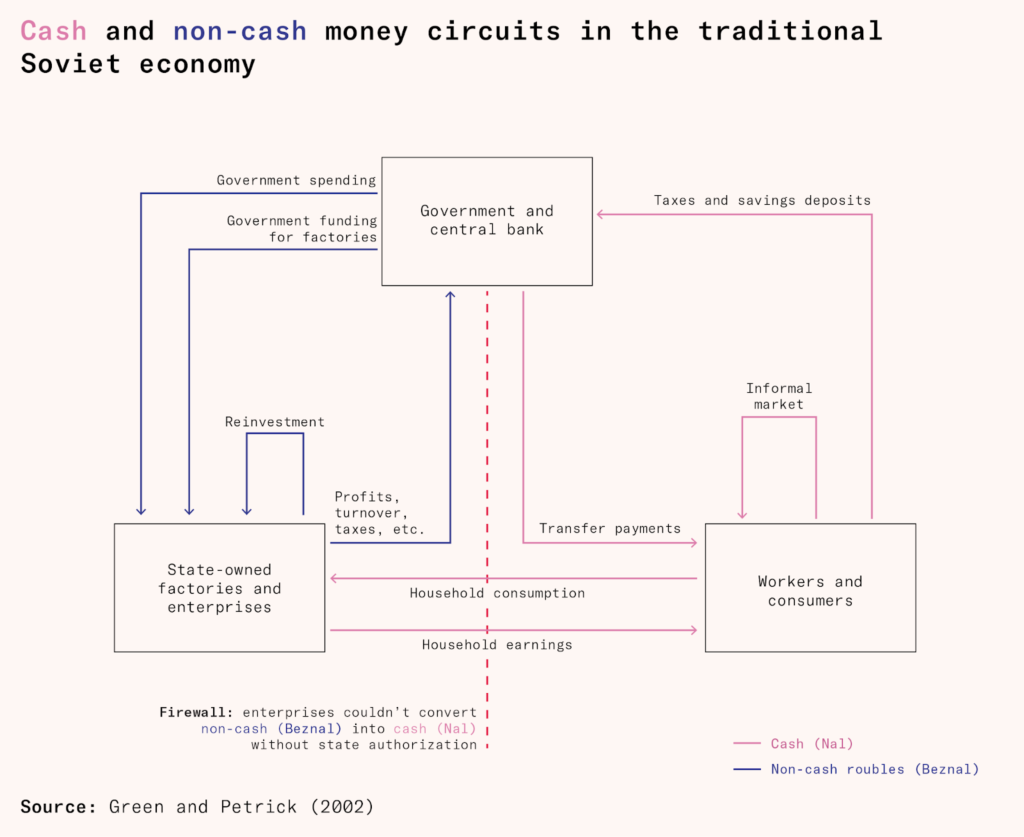
Gorbachev tore down the wall by accident. His new law on private cooperatives allowed them to convert freely between Beznal and Nal. Enterprises quickly realized they could make fake Beznal transactions with cooperatives, which would convert the funds into cash and hand most of it back, keeping a cut for themselves. Suddenly, vast amounts of hidden money entered the everyday economy.
Cash-rich state enterprises spent freely on wages, while goods remained scarce. In sectors without price controls, inflation ran rampant. In those with controls, shortages and queues grew longer. Later changes to banking rules made things even worse, as new banks failed to enforce the Nal and Beznal distinction at all.
It is still unclear whether Gorbachev and his closest advisers understood the system they had demolished. But their blunder shows how reformers, blinded by secrecy and complexity, could unleash forces they neither anticipated nor controlled.
Is communism really so bad?
‘Comprehensively build a moderately prosperous society’, Chinese Communist Party slogan.
The Soviet Union was not a poor country. While far behind Western Europe and North America, it was firmly middle-income, with living standards far above most of the world. And it paired those living standards with genuine excellence in nuclear and space technology, an enormous army that kept up with the United States until the very end of the Cold War, and an elite with world-class education. That prosperity created a problem: reform carried real risks. Elites had much to lose, and even ordinary citizens feared the disruption of hard-won stability. In today’s North Korea, though much poorer, a privileged elite in Pyongyang thrives under the system, and reform would not only strip them of status but could threaten their lives.
Communist reform was easier where planning was never consolidated. China in the 1970s and Vietnam in the 1980s both launched reforms when their systems were weak, not entrenched. Vietnam’s ‘Đổi Mới’ reforms began in 1986, after decades of war and a single failed nationwide five-year plan. Most Vietnamese lived on less than a dollar a day. In China, the Great Leap Forward and Cultural Revolution had devastated both planning and the party elite. By 1976, many leaders had survived exile and persecution, and they knew firsthand how poor rural China was. Stable planned communism had existed for at most 10 of the 27 years of the Communist era when Reform and Opening began.
Where planning worked well enough, as in the USSR, it created vested interests that blocked reform. Where it failed to take root, as in China and Vietnam, there was little to lose and much to gain.
Where is that abundance you promised?
Every communist reformer promised abundance. Yet again and again, their reforms faltered, not because they lacked ideas, but because they underestimated the scale of the task. Prices became untouchable symbols of legitimacy; the wrong sequence of reforms shattered fragile balances; leaders tinkered with systems they barely understood; elites and ordinary people who had something to lose quietly strangled change. The result was not abundance but frustration, fear, and eventually collapse.
For political movements today, the warning is not that we live under a command economy, but that winning the argument, as we are in many countries, is never enough. Systems push back. Interests entrench. Complexity hides consequences from those who think they know best. Good ideas, launched in the wrong order, can backfire.
That is why the stories of communist reform matter. If we want to reach the frontier of abundance, we must do more than draft clever reports or whisper in the ear of the powerful. We must understand the order of reform, the risks of backlash, and the realities of the systems we hope to change. We must deliver quick wins to build momentum and develop a coalition that gains at least the acquiescence of the most powerful and the masses. And perhaps most importantly, we need to make sure that prices don’t go up.
Michael Hill is a policy researcher at Britain Remade. You can follow him on Twitter.
Last year I read in quick succession "Armageddon Averted" by Kotkin, "Collapse" by Zubok, "How China Avoided Shock Therapy" by Weber, "Democracy and the Market" by Przeworski, "Deng Xiaoping and the Transformation of China" by Vogel and came to very similar conclusions about the centrality of inflation to communist legitimacy and their failure to reform. Here is the personal note (not meant for publication but too relevant to keep to myself) on my take-away from Zubok & Weber (the two I would recommend most strongly):
When there are inefficient firms, "liberalization of wages and prices" and "allowing unproductive firms go under" are the economist's obvious answers. They are also absolute chaos to those experiencing it. Following the "big bang", prices for inputs, outputs, and labor all rise in competition with each other as each agent tries to establish its position. In theory, prices will rise until the least productive firms are unable to keep up, at which time they will become bankrupt, cease paying wages, and thus end the inflationary episode by weakening demand. Temporarily slack capacity (material, plant, labor) will be purchased by more efficient firms, now with an established market economy.
The first bankruptcies occur once firms' costs outpace their revenue. While these firms produce less than they pay, that does not mean they are totally expendable. A firm paying 5,000,000 ₽ in labor and 5,000,000 ₽ in materials to produce 9,800,000 ₽ in finished goods "should" be liquidated, but in the short term that is 5,000,000 ₽ in lost wages, 5,000,000 ₽ in lost revenue to another firm, and 9,800,000 ₽ worth of lost goods. This is a dual blow to both demand and supply, and only narrows the gap between the amount goods and the money chasing it by 200,000 ₽.
The total amount of real wages needs to fall corresponds not just to the degree of inefficient production, but to offset inflationary pressure from a collapsing savings' rate. (In the Soviet Union, savings went from ~30% to ~0% as people divested from currency-denoted assets in favor of the very hard goods whose prices needed to come down). The firestorm of inflation → rising costs → bankruptcy will only extinguish when there is so much widespread unemployment that some of the increasingly scarce goods remain unsold, making firms unwilling to keep paying ever-higher costs of production themselves. In Russia, the Harvardians Larry Summers and Jeffrey Sachs oversaw 240,000% inflation, half the nation entering deep poverty (<$4/day), and a default on the sovereign debt.
"How China Escaped Shock Therapy" argues that China almost went down this path, but benefited from choosing a more gradualist approach. China used its huge size to run actual experiments, issuing special currencies so they wouldn't cross-contaminate each other: in one county they tried the neoliberal approach (deregulating prices and replacing grain quotas with a cash tax) and in the other they made a small change to the existing system (introducing a "dual track," where the government continued buying quota grain at the specified price but farmers were free to do as they wished with the surplus). In the freer trial, grain production initially shot up to chase prices but then overproduction left farmers worse off than they started. Despite this evidence, China still almost liberalized prices in 1986 and did begin in 1988. In the dual track case, what was originally an expropriating quota gradually transformed into subsidizing price floors, buffering the newly commercialized farms from the bullwhip. The social damage this unleashed led to the PRC's worst ever crisis of legitimacy (leading to the Tiananmen Massacre of 1989). It was only saved by abandoning shock therapy, and repressing the unrest.
Instead of shock therapy China's reformers settled on a piecemeal strategy Weber analogizes to Jenga: one by one, sectors would be set up to take advantage of market logic, but without ever having a single "big bang." This would limit the opportunities for run-away inflation, and since 1989 China has done a remarkable job keeping prices stable. Weber legitimizes the interventionist approach to fighting inflation by pointing to its under-appreciated success in the West. After the brutal inflation-deflation which accompanied the transition out of the World War I wartime economy, the US took a much interventionist approach to the post-World War II economy, setting the stage for three decades of roaring economic growth.
I'm a little confused...Is this an essay speaking in favor of Communism and how to manage it? I'm asking because I've been living in "Communist" China for 15 years, mostly in the middle of the country, and it's fair to say that "no one" believes that stuff. Or, are we talking about societal reform in general, i.e., how to manage reform in normal functioning societies?