
Epidurals are miraculous
Childbirth may be the most painful thing a person can experience, but we have the technology to numb the pain.


Issue 24 of Works in Progress has begun arriving with subscribers. Not subscribed? Do so here to receive this issue, plus another every two months – straight to your door.
In Irish mythology, a man forces his heavily pregnant wife, Macha, to race the King of Ulster’s horses on foot. She wins, gives birth to twins at the finish line, and then curses the warriors of Ulster: for nine generations, they will be afflicted with five days of labor pains in times of war.
Childbirth is very painful, as Irish storytellers knew when they described this curse upon the men of Ulster two thousand years ago. For many women, it will be the single most painful experience of their lives, frequently described as ‘excruciating’ and ‘unbearable’.
This pain can last a long time. Laboring women first experience increasingly frequent and intense muscular contractions, which open the cervix (the entrance of the womb) over a period of hours to days, before the baby is finally pushed out through their vagina, a process that leaves many with injuries ranging from minor to severe. In total, labor normally lasts somewhere between five and eighteen hours.
Just because that suffering is natural does not mean it is without consequence. Experiencing significant pain during labor may have enduring effects upon women; it is thought to be a risk factor for developing postnatal depression or PTSD. Women who have had traumatic births can find it more difficult to bond with their new baby and are less likely to have another child.
In Genesis, God tells Eve that ‘in sorrow thou shalt bring forth children’, but today the pain that many women experience in childbirth is effectively optional. Though a number of different pain relief options exist for laboring women, by far the most effective is epidural anesthesia. Epidurals safely remove much of the pain of childbirth for most women, while leaving the mother fully alert for the arrival of her baby.
In an epidural, a flexible tube is inserted under local anesthetic between the spinal vertebrae after the mother has begun having contractions. The analgesic, a combination of local anesthetic, opioids, and occasionally steroids that varies between hospitals, is pumped through the tube directly into the epidural space, located just outside the sac surrounding the spinal cord, where it numbs pain signals from the uterus and pelvis.
This relieves the entire lower body of pain within around half an hour. The analgesic is then continuously infused through the tube; with modern epidurals, a laboring mother can safely increase her dose at any time by pressing a button.
Epidurals have been available in some form for over a hundred years. The first successful spinal anesthesia was given in 1898 by German surgeon August Bier, who termed his method ‘cocainization of the spinal cord’, and two years later Oskar Kreis used this technique to give pain relief to six laboring women in a Swiss hospital. A technique more like the modern epidural, with medicine injected into the epidural space, was developed by Spanish military surgeon Fidel Pagés in 1921, and continuous epidural analgesia for labor was first described in 1931 by Romanian Eugen Aburel.
The modern epidural
When I gave birth to my first child on Christmas Day 2024, I asked for an epidural. Having it placed was uncomfortable, akin to a mild electric shock. But once it began to work, I felt supremely relaxed, napping and drinking tea through what should have been the most painful parts of labor. At one point, I felt some pain on the left side of my abdomen and, with a midwife’s help, turned onto my side, helping the drugs to reach those nerve roots and rapidly stopping the pain.
The epidural did not numb my lower body: I could feel the touch of my husband’s hand, contractions, and the pressure of my daughter’s head. The only missing sensation was pain. That’s because pain fibers are blocked more easily than the larger fibers that carry touch and movement. As I labored, the lack of discomfort was surreal. Perhaps because it was pain-free, I remember my daughter’s birth extremely well. I did experience one unpleasant and fairly typical side effect from the epidural: 20 minutes of shivering and itchiness shortly after it was put in place. But in comparison to what most women go through without an epidural, this seems like a very good deal.
Epidurals have other side effects. They can make birth take longer, by somewhere between fifteen minutes to an hour. In up to 20 percent of women, an epidural causes low blood pressure, though this is generally resolved with simple interventions like repositioning the woman onto her left side or giving her intravenous fluids. In up to 1 percent of women, an epidural can cause a severe headache when the needle is inserted slightly too far, puncturing the membrane around the spinal cord so that cerebrospinal fluid leaks out. This is treated by injecting a small amount of the patient’s own blood near the epidural site, which clots and seals over the puncture.
There is debate over whether or not epidurals raise the risk of an unplanned Cesarean section, but this is probably not the case. In general, establishing a causal relationship here is complicated, as women who have difficult births are more likely to have an epidural. However, one rigorous review from 2018 found that receiving an epidural does not increase women’s chance of a Cesarean section but that it does increase the risk of an instrumental birth, meaning the use of forceps or ventouse (vacuum cup) to help deliver the baby, which is associated with a higher risk of injury to the mother. However, this increased risk of instrumental birth generally does not appear in studies post-2005, possibly reflecting improvements to how epidurals are delivered, particularly the use of lower doses of pain medication so that women retain more sensation, allowing them to push the baby out more effectively.
Having an epidural can also change the way a woman is able to give birth. Moving and walking around during labor can be hampered by an epidural because the medication can make the legs feel heavy and weak, and because of the physical restriction of the epidural tube itself. But hospitals increasingly offer ‘mobile epidurals’, a technique that uses a lower dose of pain medication to preserve feeling in the legs and, thus, women’s ability to move around.
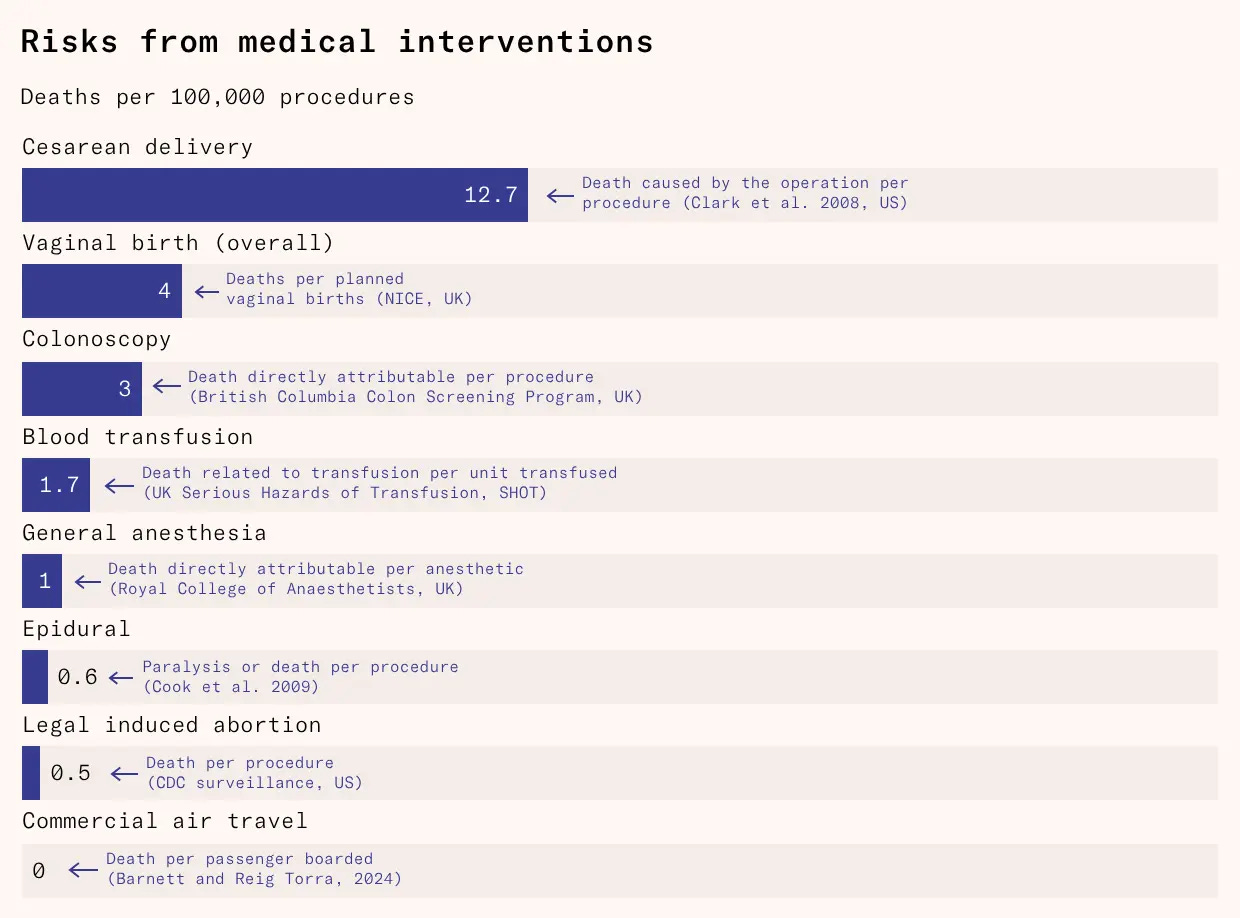
Because the epidural tube is inserted near the spinal cord, a common fear is that it might cause paralysis if misplaced. But this risk is extremely low: a 2009 study looking at serious complications from obstetric epidurals found that among the over 160,000 women who received one in NHS hospitals in Britain between 2006 and 2007, there were zero cases of permanent paralysis.
The final caveat is that epidurals do not work to the same degree for every woman. Up to 13 percent of women need their epidural tube repositioned because it has not provided full relief and around a third experience uneven or patchy pain relief, which may necessitate a higher dose of analgesic. How well an epidural works can also vary based on how quickly a woman metabolizes opioids, how much she moves, and the shape and size of her epidural space. But even women for whom an epidural does not fully work still receive some pain relief. And for most women, breakthrough pain is mild and easily fixable, as it was for me.
The popularity of epidurals
In many developed countries, epidurals are popular, with the majority or a significant minority of laboring women choosing one, especially if giving birth for the first time. Today, 79 percent of American first-time mothers, 64 percent of Irish first-time mothers and just over 50 percent of Norwegian first-time mothers have an epidural. In France, epidurals are even more popular, with 82 percent of all women giving birth vaginally receiving one.
In poorer countries, use of epidurals is often much lower, due to a lack of awareness among women, cost, and a lack of necessary equipment and staff. In China, 70 percent of women deliver with no pain relief, and the government has targets in place to improve access and so make giving birth better for Chinese women. One report suggests that in India, only around 11 percent of women receive pain relief in labor and awareness is low. A study of 200 pregnant Indian women attending one clinic found that 98 percent did not know it was possible to relieve labor pains and that none had ever heard of anyone using an epidural.
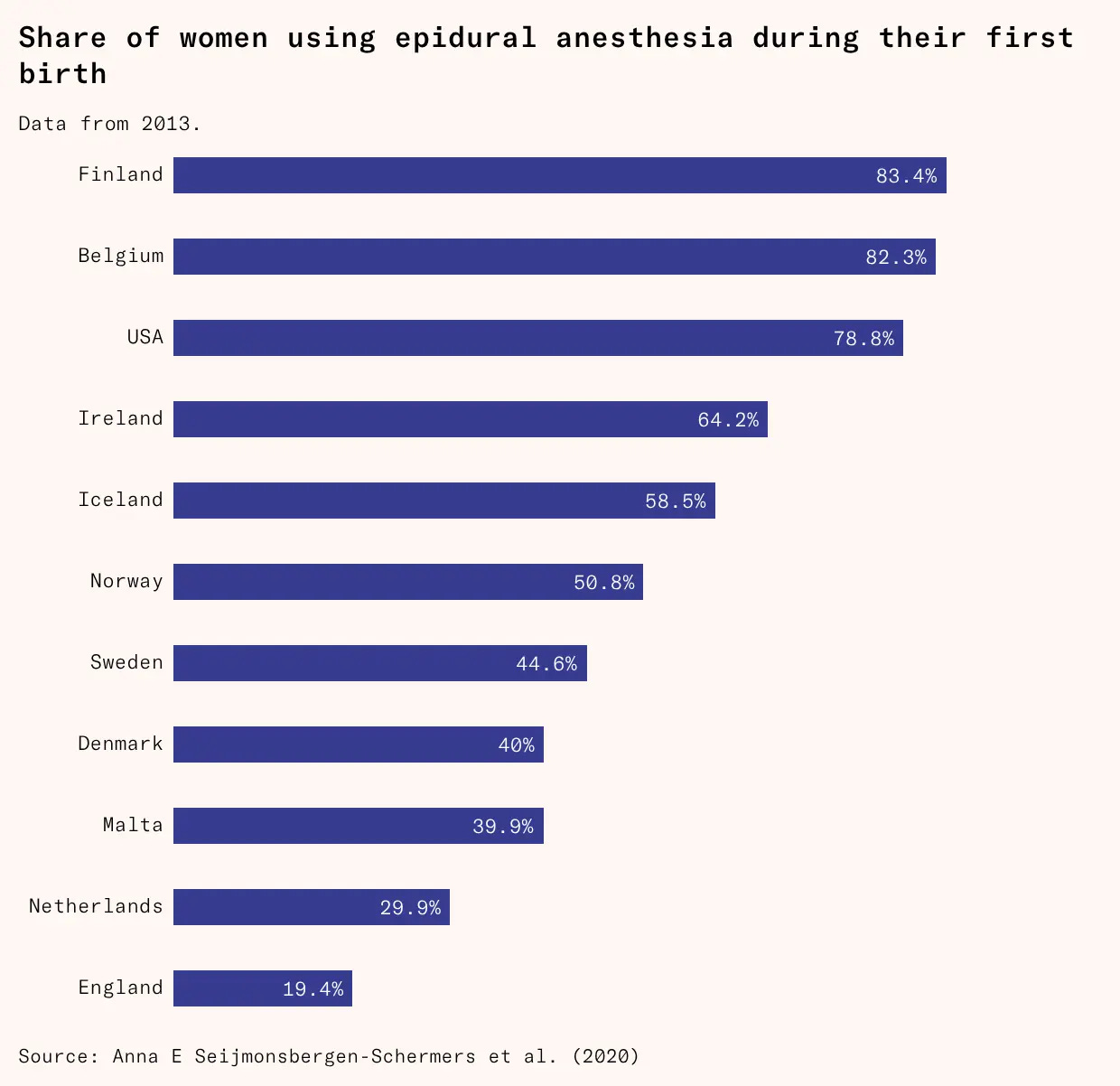
But there are also rich countries where epidurals are not the norm. Only 22 percent of Scottish women and 31 percent of English women receive an epidural for a vaginal birth. This is partly because there aren’t enough anesthetists, but also because British maternity care has a long history of promoting ‘natural birth’ and portraying epidurals as unnecessary or best avoided. In Japan, where there is also an emphasis on natural birth, only around 14 percent of women receive an epidural, though this is a sharp increase from 5 percent in 2018. Epidurals are not covered by Japanese public health insurance. In countries like Britain and Japan, where cost is not a constraint, cultural factors still limit women’s ability to freely choose a painless birth.
Childbirth is as unpredictable and exciting as it is arduous and gruelling. But Macha’s curse has lost its sting: the pain that our female ancestors had no choice but to endure is now avoidable. Epidural anesthesia gives women the choice to safely opt out of what might otherwise be the most painful experience of their lives.
Phoebe Arslanagic-Little researches ways to make it easier for people to start families.
Illustration by Shuyan Chen.
 | A guest post by
|
Thank you for this piece. I wanted to add an additional perspective to the line about accidental dural puncture causing "a severe headache" that is then described as being treated via an epidural blood patch. Unfortunately, an epidural blood patch is not always curative and for a subset of patients, the dural puncture turns into a chronic, post-puncture spinal cerebrospinal fluid (CSF) leak.
While my own spinal CSF leak was sustained via lumbar puncture (LP), not epidural, the reality for all of us is far more than the temporary headache I was warned about. Spinal CSF leak is a debilitating neurological condition that affects many systems in the body, not a passing headache.
Following my LP, I had four blood patches with blood and fibrin glue, none of which provided lasting relief. Unfortunately, some epidural patients suffer the same trajectory.
None of this is an argument against epidurals, of course! I'm glad they exist and that they help women through childbirth. I wanted to comment on the brief mention of risks, however, because there are profound barriers to care in seeking treatment for spinal CSF leak, even when a known puncture occurred. (For more on these barriers, we recently published a paper on the fractured and lengthy path to care with spinal CSF leak: https://www.ajnr.org/content/early/2026/06/08/ajnr.A9459) New mothers are sometimes told it's hormones, it's anxiety, or it's post-partum adjustment, when in reality their symptoms are caused by a spinal CSF leak.
I appreciate this article, and wanted to make mention of the full range of outcomes, including the underdiagnosed one I'm still living with, so that patients who don't recover quickly are believed and diagnosed quickly rather than dismissed.
Great essay