


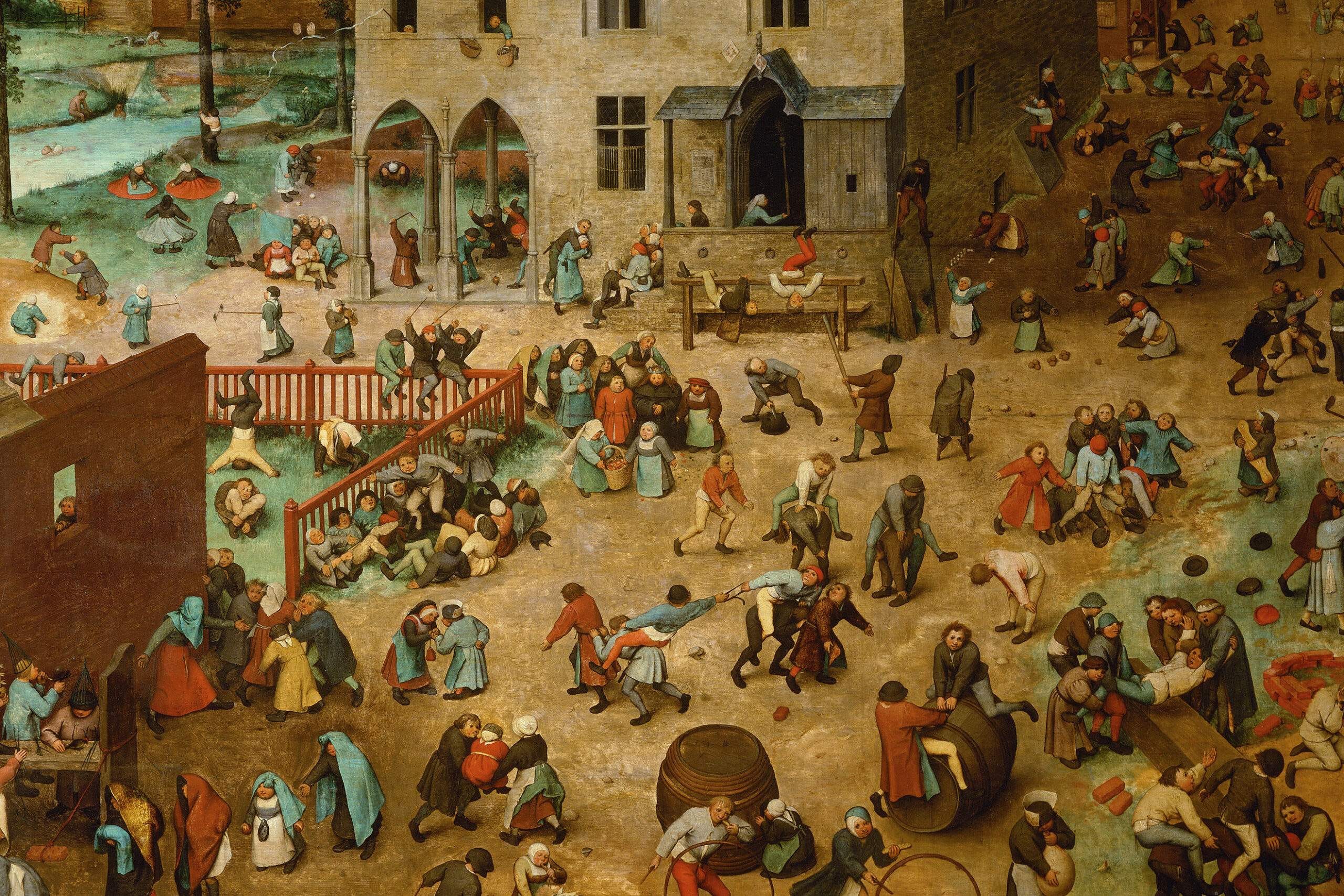
Growing up, I acquired a vague idea that medieval people did not view childhood as we do. I was told they saw children merely as defective or incomplete adults, and that they did not love their children as we love ours, perhaps as a way of coping with high infant mortality. As I grew older, I came to associate this idea with the name of Philippe Ariès, a French historian who argued in the 1960s that medieval childhood was profoundly remote in these ways. Ariès’s work never attained complete acceptance in academia, but it was vastly influential on the wider public.
As it turns out, however, Ariès’s view is just not true. This has been established beyond doubt by a wealth of later scholarship across Europe. Nicholas Orme’s Medieval Children is the leading study for England in particular. ‘It cannot be overemphasised that there is nothing to be said for Ariès’s view,’ Orme notes. It is mistaken ‘not simply in detail but in substance. It is time to lay it to rest.’
It is sometimes imagined that medieval people had a great many children. This was not generally the case. Very large families occasionally occurred, but most medieval people had only three or four children, somewhat more among the rich and somewhat fewer among the very poor. At least in England, this was partly because they married quite late, generally in their mid or late twenties. About 25 percent of children died in their first year and another 15 percent by their tenth. The median English child thus grew up in a home with one sibling and two parents in their thirties or forties, being in this respect just like the median English child today. Surviving grandparents often lived nearby, but rarely under the same roof.
Abortion was considered sinful, but the situation was more complicated than might be supposed. Medieval people did not think that early-term fetuses had souls, believing them to be alive but unconscious, like vegetables. Early-term abortion was thus not considered homicide, and was not punishable at common law, though a church court might impose a penance like regular fasting or almsgiving. Late-term abortion was thought to be a kind of homicide, but was not normally punished at common law either. This distinction persisted until the nineteenth century.
Medieval parents made immense sacrifices for their children, and seem to have expected little in return. Feeding a child consumed about 15 percent of average income, and parents often continued to support children throughout their adulthood. Older children often performed light work at home, but at just the age they might become a net economic asset – 13 or 14 – they were usually sent away to acquire skills and savings through apprenticeship or working in service. They may have remitted some of this income to their parents, but this was not standard, and in fact parents generally paid for their children’s apprenticeships. Grateful children sometimes supported their parents in old age, but again this does not seem to have been the norm.
Medieval England was often at war, and the government was desperately in need of soldiers. The Crown repeatedly issued decrees banning ‘dishonest and useless’ ballgames like football, requiring boys over the age of seven to practice archery instead. Needless to say, English boys could not be stopped from playing football, and the decrees were widely ignored.
Child mortality was high, but there is no reason to think that parents were indifferent to it. Few diaries or letters survive in which they expressed their grief, but it was sometimes recorded by others. The fifth child of Henry III and Eleanor of Provence was called Katherine. Katherine was born disabled and never learned to speak, and she died when she was three years old. Both her parents were heartbroken. The chronicler Matthew Paris wrote that Queen Eleanor fell sick with grief, ‘and could find no relief in medicine nor human consolation’.
Parents also took joy in their children, and vice versa. An Oxford schoolbook of the 1490s describes a schoolboy returning home for the holidays. Upon meeting his parents, ‘we wept for joy, each to other’. The thirteenth-century treatise Ancrene Wisse imagined Jesus playing with a Christian believer as a mother does with her child. ‘She runs away from him and hides herself, and lets him sit alone and look anxiously around, and call “Dame! Dame!” and weep a while. Then she jumps out laughing, with outstretched arms, and embraces and kisses him and wipes his eyes’.
The medieval people who emerge from Orme’s book are quite unlike the strange and cold figures that we have been led to imagine. ‘I believe they were ourselves, five hundred or a thousand years ago’, Orme writes. Perhaps we should ask why the Ariès hypothesis ever exercised such a hold over the popular imagination. Was it ever really plausible that children survived the terrible hardship of medieval life without devoted parents? Next time a scholar makes exciting claims about how some class of human beings is incomprehensibly unlike us, we would do well to ask similar questions.
Samuel Hughes is an editor at Works in Progress.
There are two claims in this article which are blurred together and that Ariès himself did as well, only in reverse.
One is affective (psychological): did medieval parents love and grieve their children? Orme and other later scholarship have settled that decisively, indeed.
The other is institutional: was childhood constituted as a distinct, protected, economically useless life stage? That's a different question entirely, and demolishing the first doesn't affect the second.
Timeframes are important and also the Hajnal-pattern Northwest Europe - the article clearly focuses on medieval England, so that is clarified. This is important because the industrial factory child will then become the historical anomaly in an opposite direction: a period where child labour was more economically extractive than what preceded it. And the more recent historic memory of the exploitative childhood is arguably one element that made Ariès's claims plausible.
The end of the article is arguably the most problematic as it overreaches: "They were ourselves" is true of grief and play and affection, but it slides from continuity of sentiment to continuity of childhood as a category, which is exactly the conflation that made Ariès's weaker claims plausible in the first place. The reconstruction of medieval life in the media (film/TV and easy reading literature) also frames medieval Europe as a place of plague, revolt and arbitrary lordly violence - which lends itself better to an image of traumatised childhood than one of middle class styled one, where parents played with kids and sent them away to apprenticeships.
Also, Orme's examples are taken from the urban, gentry, or clerical milieus and used to generalize about a population that was around 80-90 percent rural and engaged in subsistence agriculture. And who's children kept working the same strips of land their fathers worked, often the same land their grandfathers worked, because there was nowhere else to go and no craft to be apprenticed into.
A great window into the amount of love and adoration parents had for their children, read The Pearl, a 14th century poem of grief suffered by a father for his dead daughter. I believe it’s anonymous. Deep stuff.